Finance
6 mins
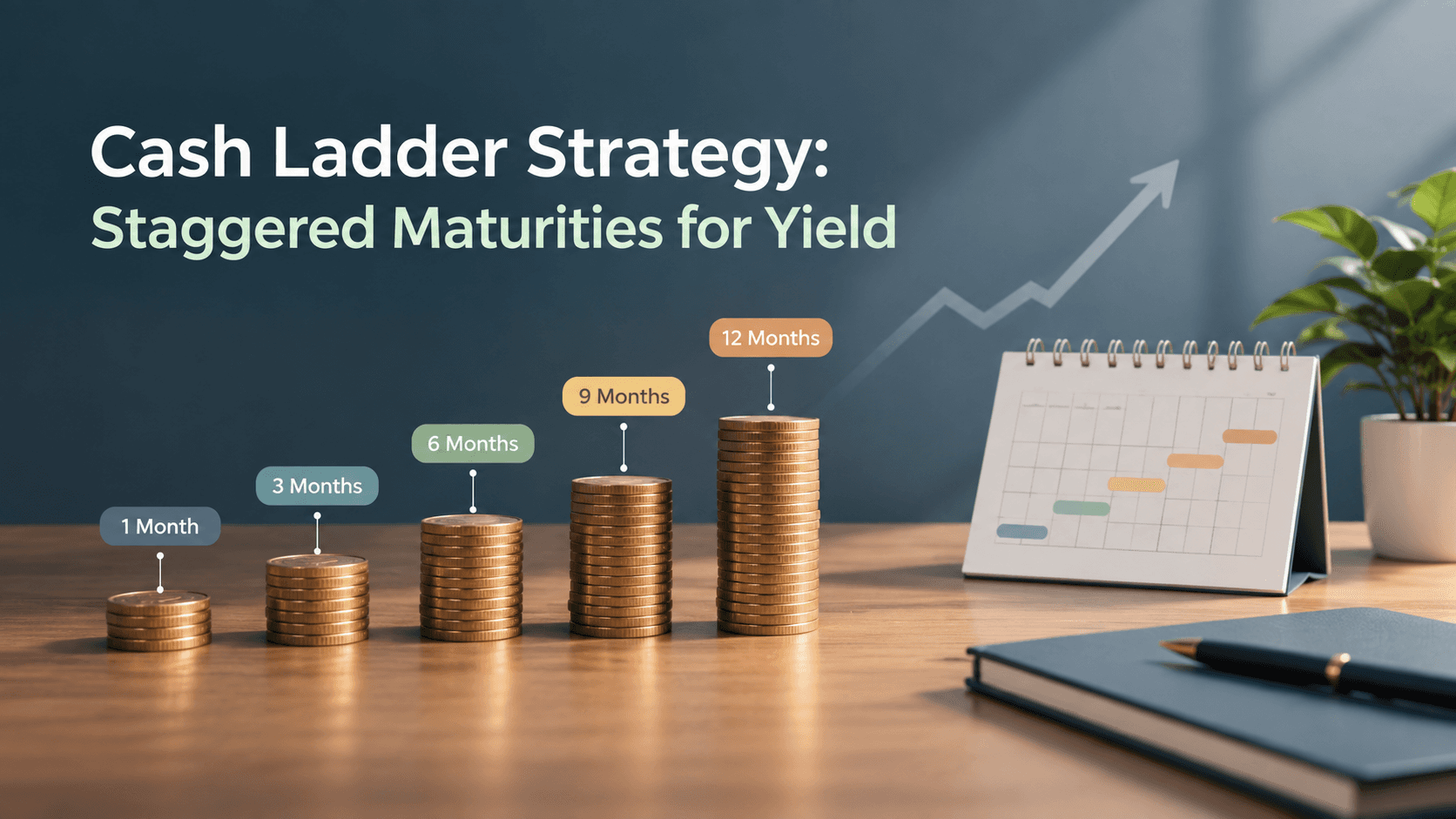
Most businesses treat their surplus as one decision, pick an instrument, put everything into it, done. That approach forces a trade-off: go fully liquid and accept lower returns, or lock in a better rate and give up flexibility. A cash ladder avoids that trade-off entirely by splitting surplus across several maturities instead of one. Good surplus cash management often comes down to exactly this kind of structure, matching different portions of surplus to different time horizons rather than making a single, all-or-nothing call.
This piece covers how a cash ladder actually works, the two practical ways businesses can build one, and a worked example showing what it looks like in practice.
What is a cash ladder strategy?
A cash ladder, also called a maturity ladder, splits a lump sum of surplus into several smaller portions, each placed in an instrument with a different maturity date. As each portion, or "rung," matures, the business either uses the funds if needed or reinvests them, typically at the longest maturity in the ladder, to keep the structure going. The result is a portfolio where something is always maturing soon, while the rest continues earning at whatever rate applies to its longer tenure.
How does cash laddering actually work?
The mechanics are straightforward once the concept clicks. Instead of putting the full amount into one instrument for one fixed period, you divide it across multiple instruments with staggered maturities, say, one month, three months, six months, and twelve months out. Each rung earns a return appropriate to its own tenure, and because the rungs mature at different times, you're never facing an all-or-nothing choice between accessing your money and earning a decent return on it.
Mutual fund investments are subject to market risk. Please read scheme-related documents carefully before investing. Past performance is not indicative of future returns.
Building a ladder using FDs vs. using fund categories
Businesses generally have two practical ways to build this structure. The first, more traditional approach uses staggered fixed deposits, splitting surplus into FDs with tenures like 3, 6, 9, and 12 months. This is a well-established technique in India, and works reasonably well, though it comes with the usual FD trade-offs, an early-exit penalty if a rung needs to be broken before maturity.
The second approach, generally better suited to corporate surplus that needs more flexibility, uses debt fund categories instead of FDs as the rungs: overnight funds for the shortest horizon, liquid funds for a few weeks out, money market funds for a couple of months, and corporate bond or longer-duration funds for the furthest rung. This version keeps the same staggered-maturity logic while retaining the ability to redeem most rungs without a penalty if plans change. We've covered these instrument categories in detail here: Best low-risk options to invest idle cash in 2026
A worked example: laddering ₹1 crore of corporate surplus
Rung | Amount | Instrument | Horizon |
1 | ₹25 lakh | Overnight fund | Same day to 1 week |
2 | ₹25 lakh | Liquid fund | 2-4 weeks |
3 | ₹25 lakh | Money market fund | 1-3 months |
4 | ₹25 lakh | Short-tenor FD or corporate bond fund | 6-12 months |
As rung 1 turns over, it can be redeployed based on near-term needs. As rung 4 approaches maturity, the business can decide whether to extend the ladder outward again or pull that portion back into shorter-duration instruments if the cash is needed sooner than expected.
How to decide the number and spacing of rungs
There's no fixed rule here, but a few things guide a reasonable structure. More rungs generally means more granular liquidity, but also more instruments to track and manage, so most businesses settle on three to five rungs as a practical balance. Spacing should reflect actual, realistic cash flow patterns; businesses with predictable, steady obligations can space rungs further apart, while those with more variable near-term needs benefit from tighter spacing in the shorter rungs specifically.
What happens when a rung matures
This is where the discipline actually matters. When a rung comes due, the default shouldn't be letting it sit in a current account while someone decides what to do next. Either redeploy it based on a genuine near-term need, or roll it back into the ladder, typically reinvesting at the longest rung to keep the structure intact. Skipping this step regularly is how a well-designed ladder quietly degrades back into idle cash sitting untouched.
The benefits: Balancing liquidity and yield without guessing rate direction
The real advantage of a ladder isn't just balancing liquidity and yield, it's removing the need to correctly predict where rates are headed before deploying surplus. If rates rise, the shorter rungs mature soon and can be reinvested at the new, higher rate. If rates fall, the longer rungs already locked in the earlier, better rate continue earning it regardless. A single, all-in decision forces you to bet on a direction. A ladder doesn't.
We've covered how this kind of structure fits into a broader deployment plan here: How to deploy idle cash without compromising liquidity
FAQs
1. What is a cash ladder strategy?
A cash ladder splits surplus cash across multiple instruments with staggered maturity dates, so a portion is always maturing soon while the rest continues earning at longer, typically better, rates.
2. How does cash laddering work for a business specifically?
A business divides its surplus into rungs, matched to different time horizons, using instruments like overnight funds, liquid funds, money market funds, and longer-duration options, so it always has access to some cash without giving up yield on the rest.
3. What's the difference between an FD ladder and a fund-based ladder?
An FD ladder uses staggered fixed deposits and carries an early-exit penalty if broken before maturity. A fund-based ladder uses debt fund categories like liquid and overnight funds instead, generally offering more flexibility to redeem without penalty.
4. How many rungs should a corporate cash ladder have?
Most businesses use three to five rungs as a practical balance between granular liquidity and manageable complexity, though the exact number depends on how predictable the business's near-term cash needs actually are.
5. Does a cash ladder protect against interest rate changes?
To a meaningful degree, yes. If rates rise, shorter rungs mature soon and reinvest at the higher rate. If rates fall, longer rungs already locked in continue earning the previous, better rate, reducing the impact of guessing wrong on rate direction.
6. What happens if a business needs cash from a rung before it matures?
With a fund-based ladder, most rungs can be redeemed without penalty. With an FD-based ladder, breaking a rung early typically incurs a small penalty on the interest earned, though the principal remains accessible.
Back to all notes
Finance
5 mins
Idle Cash vs Working Capital: What's the difference and why CFOs mix them up?
Working capital is a specific accounting measure, current assets minus current liabilities. Idle cash is a subset of a business's cash balance that has no near-term purpose and isn't earning a return. The two get conflated often, but treating all working capital as untouchable, or all idle cash as part of the working capital buffer, both lead to real mistakes.
Finance
6 mins
Treasury Bills (T-bills) vs Liquid Funds: Which is better for Idle Corporate Cash?
Treasury bills and liquid funds are both low-risk, short-duration instruments, but they're structured very differently; one is a direct, held-to-maturity government security, the other is a professionally managed, NAV-based fund. This piece compares how they actually work, their returns, liquidity, and safety, and which fits which kind of corporate surplus.
Idle Cash Investment
5 mins
How to set up an idle cash investment policy: A step-by-step template for finance teams
An idle cash investment policy is a short, written document defining how much buffer to keep liquid, which instruments are approved for surplus, who can approve what amount, and how often the policy gets reviewed. This piece is a practical, section-by-section template businesses can actually build from.