Finance
6 mins
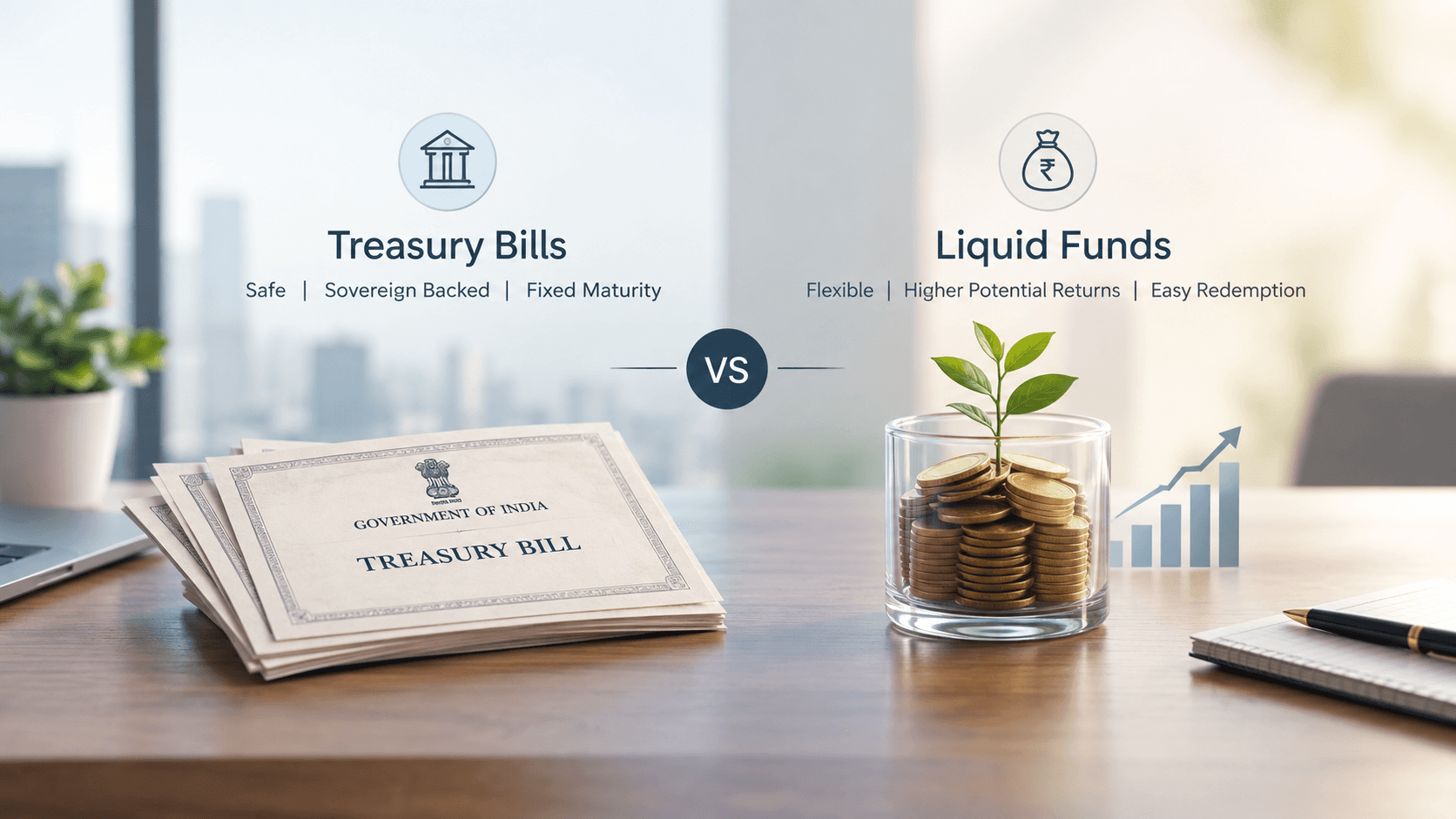
Treasury bills and liquid funds often get mentioned in the same breath as "low-risk short-term options," which is true but doesn't say much about how differently they actually function. A T-bill is a direct government obligation you hold to maturity. A liquid fund is a pooled, professionally managed vehicle you can exit almost anytime. Good surplus cash management means understanding that structural difference before defaulting to whichever one sounds more familiar.
This piece compares the two directly, how they work, what they return, and which corporate surplus each one actually fits.
What are treasury bills, and how do they actually work?
Treasury bills are short-term government securities issued by the RBI on behalf of the Government of India, in 91-day, 182-day, and 364-day tenors. They're zero-coupon instruments, issued at a discount to face value and redeemed at par, so the return comes entirely from the difference between the purchase price and the redemption amount, rather than a periodic interest payment. Because they're backed by the sovereign, T-bills sit close to the risk-free end of the spectrum.
How do businesses buy treasury bills in India?
T-bills are issued through regular RBI auctions, typically weekly, using a multiple price method where competitive bidders submit yield-based bids electronically through the RBI's E-Kuber system. For businesses without direct access to that system, the RBI's Retail Direct platform provides a more accessible route, allowing non-competitive bidding, where the investor accepts the weighted average yield from the competitive auction rather than specifying a bid themselves. This route is open to a wide range of investors, including businesses, without needing a large treasury desk or institutional relationship.
What is the return on T-bills vs liquid funds?
This varies with the rate environment, but current data gives a useful snapshot. At the RBI's auction on September 2, 2026, for a notified amount of ₹24,000 crore across 91-day, 182-day, and 364-day T-bills, the 91-day implicit yield at cutoff came in at roughly 5.26% per annum. Liquid funds, which hold a mix of short-term debt and money market instruments, have historically delivered comparable to somewhat higher returns, often in the 6% to 7% range, though this depends on the specific fund and prevailing conditions. Neither return is fixed for the future; T-bill yields move with each new auction, and liquid fund returns move with the underlying debt market.
Mutual fund investments are subject to market risk. Please read scheme-related documents carefully before investing. Past performance is not indicative of future returns.
The structural difference: held-to-maturity vs NAV-based
A T-bill is a single, direct security. You buy it at a specific auction, at a specific yield, and hold it to a fixed maturity date; there's no daily valuation to track, and no fund manager making allocation decisions on your behalf. A liquid fund is a pooled vehicle holding a basket of short-term instruments, priced daily through its Net Asset Value, with a fund manager continuously rotating holdings as instruments mature and new opportunities arise. This is the core trade-off: a T-bill gives you certainty and simplicity for a fixed period, while a liquid fund gives you ongoing, professionally managed flexibility.
Liquidity comparison: Can you exit a T-bill early?
This is where liquid funds have a clear structural edge for most corporate cash needs. A T-bill purchased through RBI Retail Direct is generally intended to be held to maturity; exiting early isn't a straightforward redemption the way it is with a fund, and typically requires selling in the secondary market, which introduces price risk and isn't always practical for a business managing operational surplus. Liquid funds, by contrast, are built for exactly this kind of flexibility; redemptions typically process within one working day, with many funds offering instant redemption on a portion of the amount.
Safety comparison: Sovereign backing vs fund credit quality
T-bills carry sovereign backing, about as close to risk-free as an Indian rupee instrument gets, since the Government of India stands behind the obligation. Liquid funds don't carry that same direct government guarantee; their safety instead comes from holding high-quality, short-duration debt instruments, which keeps credit and interest rate risk low but not entirely eliminated. For a business prioritizing absolute minimum credit risk over flexibility, T-bills have a genuine edge here.
Which is better for idle corporate cash?
It depends entirely on the certainty of your time horizon. If a business knows precisely when a portion of surplus will be needed, say, a payment due in exactly 91 days, a T-bill maturing on that date offers simplicity and near-zero credit risk with no ongoing management required. If the timeline is less certain, which describes most operating surplus, a liquid fund's flexibility to redeem on short notice without penalty is usually the more practical fit. We've covered how liquid funds work in more detail here: What are liquid mutual funds? A complete guide for businesses
For a broader look at how T-bills fit alongside other short-term options available to Indian businesses, this covers the full comparison: Short-term investment options for businesses in India (2026 guide)
FAQs
1. Are treasury bills better than liquid funds for businesses?
It depends on your time horizon. T-bills fit well when you know precisely when the cash will be needed, since they mature on a fixed date with sovereign backing. Liquid funds fit better when the timeline is less certain, since they offer flexible, penalty-free redemption.
2. Can companies invest in treasury bills in India?
Yes. Businesses can participate in RBI T-bill auctions directly, or more accessibly through the RBI Retail Direct platform, without needing a large treasury desk or institutional banking relationship.
3. What is the return on T-bills vs liquid funds?
T-bill yields are set at each RBI auction and move with market conditions, recently around 5.26% for the 91-day tenor. Liquid funds have historically delivered somewhat higher returns, often in the 6% to 7% range, though this varies with the fund and prevailing rate environment.
4. How do businesses buy treasury bills?
Through RBI's regular auctions, either via competitive bidding on the E-Kuber system or, more practically for most businesses, through non-competitive bidding on the RBI Retail Direct platform.
5. Can a business exit a T-bill before it matures?
Not as easily as redeeming a liquid fund. T-bills purchased through Retail Direct are generally intended to be held to maturity, and exiting early requires the secondary market, which introduces price risk.
Back to all notes
Finance
5 mins
Idle Cash vs Working Capital: What's the difference and why CFOs mix them up?
Working capital is a specific accounting measure, current assets minus current liabilities. Idle cash is a subset of a business's cash balance that has no near-term purpose and isn't earning a return. The two get conflated often, but treating all working capital as untouchable, or all idle cash as part of the working capital buffer, both lead to real mistakes.
Idle Cash Investment
5 mins
How to set up an idle cash investment policy: A step-by-step template for finance teams
An idle cash investment policy is a short, written document defining how much buffer to keep liquid, which instruments are approved for surplus, who can approve what amount, and how often the policy gets reviewed. This piece is a practical, section-by-section template businesses can actually build from.
Finance
6 mins
What is Ladder Strategy for Idle Cash?
A cash ladder splits surplus across instruments with staggered maturities, so a portion is always coming due while the rest continues earning at slightly better rates. This piece covers how the strategy works, how to build one using either FDs or short-duration fund categories, and a worked example for corporate surplus.