Idle Cash Investment
5 min read
EY's India Corporate Treasury Survey 2025 found that over 70% of Indian treasury teams still rely on spreadsheets and scattered data to track cash. That's worth sitting with for a second. If you don't have a clear, real-time picture of your cash position, deploying any of it feels risky, because you genuinely can't tell what you can afford to move.
The fix isn't avoiding deployment. It's building enough structure that you know, with confidence, what's safe to put to work and what isn't.
Why deployment feels riskier than it actually is
The hesitation usually comes down to one thing: uncertainty about whether the cash being deployed might actually be needed sooner than expected. That's a real risk if you're deploying blindly, moving a lump sum into one instrument without much thought. It's a much smaller risk if you match each portion of your surplus to an instrument with a liquidity profile that fits.
We've covered what actually counts as surplus versus what shouldn't move at all here: What is idle cash?
Build a liquidity ladder instead of one lump decision
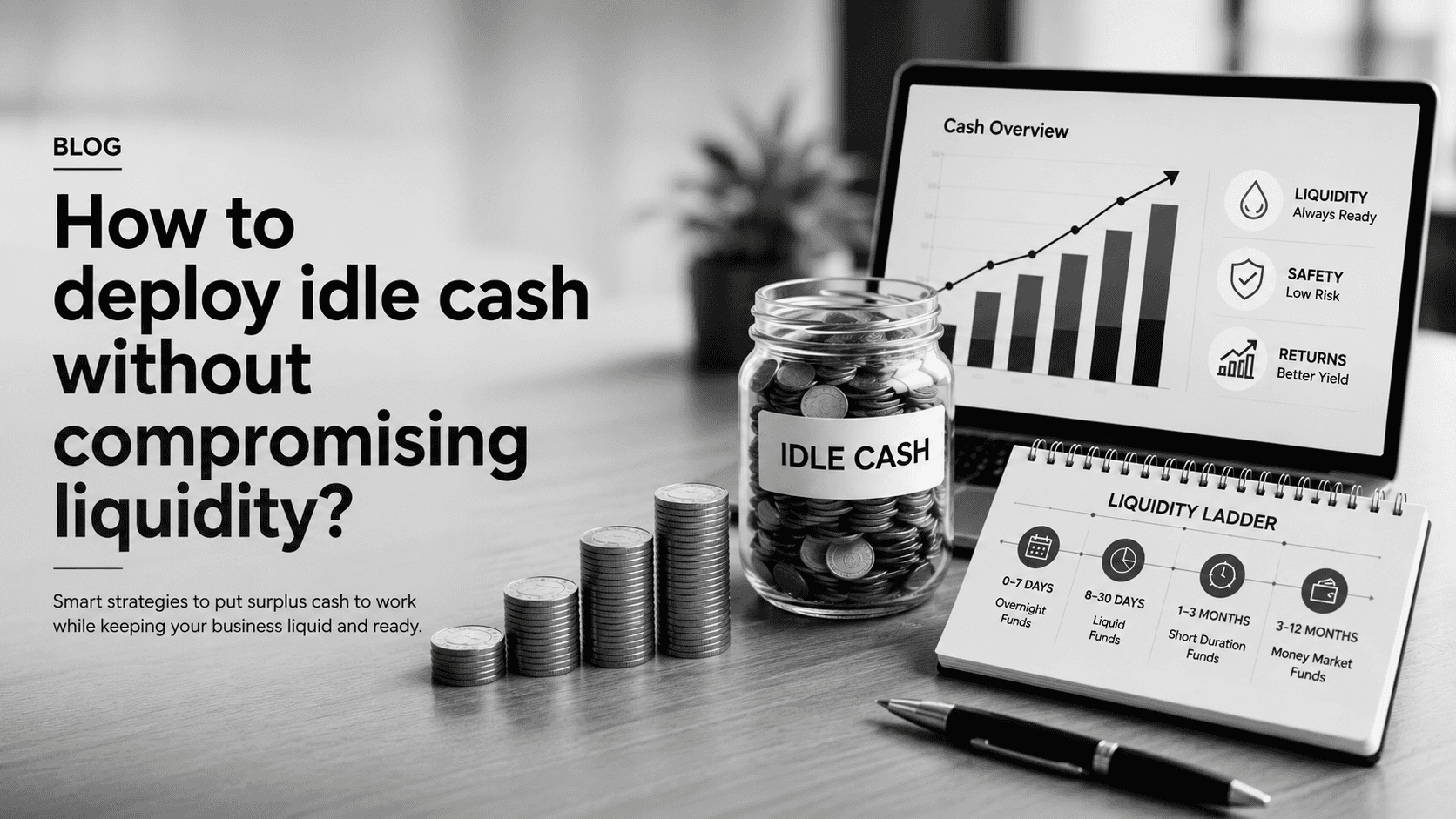
Rather than treating all your surplus as one block, split it by how soon you might realistically need it back. This is sometimes called a liquidity ladder, and it's the single biggest thing that removes the fear of deploying cash.
Layer | Time horizon | Where it typically goes |
Immediate access | 0 to 7 days | Overnight funds |
Short-term | 1 to 4 weeks | Liquid mutual funds |
Medium-term | 1 to 3 months | Liquid funds |
Longer-term surplus | 3+ months | A slightly higher-yield mix, if volatility is genuinely acceptable |
Each layer earns more than a current account, and each one keeps access proportional to how soon that portion might actually be needed. Nothing here requires locking money away for longer than you're comfortable with.
Work out how much to deploy before deciding where
Before choosing instruments, get a clear number on what's actually available to move. Two checks help:
Look at your cash ratio: Cash and equivalents divided by current liabilities. A ratio comfortably above 1 usually means you're holding more than you need for near-term obligations.
Run a short rolling forecast: Even 4 to 6 weeks out is enough to see what's genuinely unclaimed versus what's earmarked for something specific.
Once you have that number, the liquidity ladder tells you how to split it. Don't skip this step. Deploying an amount you haven't actually verified as surplus is where liquidity problems start.
Choosing the right instrument for each layer
For Indian businesses, the instruments that typically fill each rung of the ladder look like this:
Instrument | Redemption time | Best for |
Overnight funds | Within 1 working day | Cash you might need the very next day |
Liquid mutual funds | Within 1 working day, with instant redemption on part of the amount | Cash needed within days to a few weeks |
For a deeper look at how these compare and where else surplus can go, this has the full breakdown: Smart ways to earn more on idle cash
Mutual fund investments are subject to market risk. Please read scheme-related documents carefully before investing. Past performance is not indicative of future returns.
A simple process for deploying surplus
Once the ladder and instruments are decided, the actual deployment process should be repeatable, not a one-off decision made under pressure.
Confirm the surplus amount using your cash ratio and forecast.
Slot it into the ladder based on a realistic time horizon, not guesswork.
Move it into the matching instrument for each layer.
Review the whole position on a fixed schedule; weekly or biweekly works for most businesses.
Adjust the split if your near-term needs change materially.
That last step matters more than people expect. A liquidity ladder built once and never revisited eventually stops matching how the business actually operates.
Mistakes that actually create liquidity problems
Ironically, most liquidity problems don't come from deploying cash. They come from doing it carelessly.
Deploying without a real forecast: If you don't know your near-term needs, any deployment is a guess.
Putting everything in one instrument regardless of time horizon: This is what makes deployment feel risky in the first place.
Treating a one-time exercise as done forever: Business needs shift. A ladder that made sense six months ago might not fit today.
No one owns the review: Without a clear owner and a fixed schedule, deployed cash tends to get forgotten just like idle cash does.
Keeping this consistent instead of doing it once
The mechanics here aren't complicated. What's hard is doing them every week, forecasting, checking the ratio, adjusting the ladder, without it slipping once things get busy. That's usually the exact problem a dedicated cash management platform is built to solve.
If spreadsheets are where your cash tracking currently lives, it might be worth seeing what this looks like without them. Take a look at KodoNorth, or request early access to see it in action.
FAQs
1. Is it risky to deploy idle cash into mutual funds?
Liquid and overnight funds carry low risk and high liquidity, but they aren't risk-free like a bank deposit. Understanding the specific risk profile of each instrument before deploying is worth the time.
2. How do I know how much cash is actually safe to deploy?
Check your cash ratio and run a short rolling forecast. Anything beyond your operating needs and buffer is generally safe to move.
3. Can I get my money back quickly if deployed in a liquid fund?
Yes, most liquid funds process redemptions within one working day, and some offer instant redemption on a portion of the amount.
4. How often should a liquidity ladder be reviewed?
Weekly or biweekly works for most businesses. Review more often if your cash needs are changing quickly, such as after a funding round or a major expense.
Back to all notes
Finance
5 mins
How to reconcile and track idle cash across multiple bank accounts?
Businesses with cash spread across multiple bank accounts face two related but distinct challenges: reconciling each account against the ledger for accuracy, and consolidating all accounts into one view for visibility. This piece separates the two, walks through a practical reconciliation workflow, and covers how gaps in either one let idle cash hide unnoticed.
Finance
5 mins
How much cash should your business keep? A guide to calculating your optimal cash buffer
There's no universal answer to how much cash a business should hold, but there are real, calculable methods for arriving at a number specific to your business. This piece walks through four approaches, from a simple rule of thumb to a formal economic model, and how to combine them into a practical buffer size.
Finance
4 mins
What Global Fintech Fest 2026 signals for the future of AI-native treasury
Global Fintech Fest 2026, held in Mumbai from September 8-11, built its entire agenda around agentic AI, alongside tokenization and quantum computing. The event itself wasn't treasury-focused, but the concept of agentic AI is directly relevant to what "AI-native" actually means for corporate treasury tools going forward. This piece covers what the event actually addressed, and draws the connection honestly rather than overstating it.