Finance
5 mins
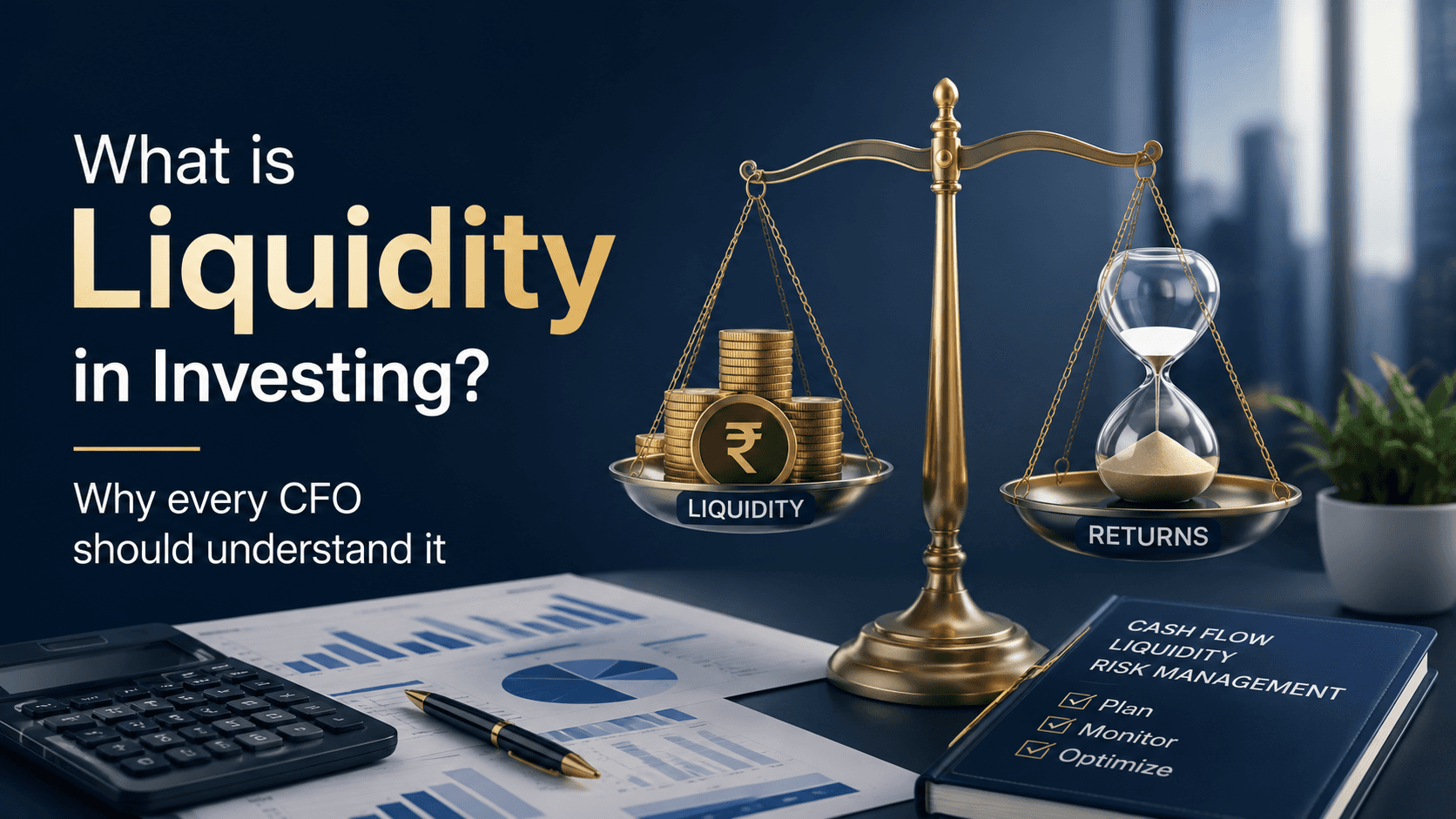
A business can be profitable on paper and still run into serious trouble if it can't convert assets into cash fast enough to meet an obligation. This is why idle cash management is a critical part of corporate treasury strategy. By ensuring surplus funds remain liquid while earning competitive returns, businesses can strengthen cash flow, reduce financial risk, and stay prepared for unexpected obligations.
What is liquidity in investing?
Liquidity refers to how quickly an asset can be converted into cash without a significant loss in value. Cash itself is the most liquid asset by definition. A government treasury bill is highly liquid, since it can typically be sold or redeemed quickly at close to its stated value. A commercial property, by contrast, is illiquid; it might take months to sell, and a rushed sale often means accepting a lower price than the asset is actually worth.
Every investment sits somewhere on this spectrum. Understanding where matters more than most CFOs give it credit for, because liquidity determines what a business can actually do with an asset when it urgently needs to.
Why liquidity and risk are inseparable
Liquidity risk is the possibility that an asset can't be converted to cash quickly enough, or without a meaningful loss, when it's actually needed. This is a distinct kind of risk from credit risk (the chance an issuer defaults) or market risk (the chance an asset's value falls). A business can hold a perfectly safe, high-quality asset and still face real trouble if that asset can't be liquidated fast enough to cover a payment due next week.
This is exactly why liquidity risk deserves separate attention from a CFO, rather than being folded into a general sense of "how risky is this investment." An asset can score well on safety and still score poorly on liquidity, and it's usually the liquidity gap that catches finance teams off guard, not the safety one.
The different types of liquidity a CFO should know
Liquidity shows up in a few distinct forms, and it's worth being able to tell them apart.
Market liquidity is about how easily an asset can be bought or sold in the market without moving its price. A widely traded government bond has high market liquidity. A small, thinly traded corporate bond does not.
Funding liquidity is about a business's own ability to meet its obligations as they come due; essentially, does the business have enough accessible cash or credit to cover what it owes right now?
Asset liquidity refers to how quickly a specific holding, a fund, a bond, a deposit can be converted to cash. This is the version most relevant to day-to-day treasury decisions, since it determines how fast surplus cash parked in an instrument can actually be accessed again.
How liquidity risk actually shows up in a business
Liquidity risk isn't theoretical. It shows up concretely, and often at the worst possible moment, when a company that's otherwise solvent can't meet a near-term obligation because its assets aren't liquid enough to convert in time. The consequences of getting caught in that gap can be severe: recovery rates for creditors in India's insolvency resolution process nearly halved in FY26, dropping to 23% from 46% the year before, according to a report by ratings agency Icra, driven largely by rising delays in the resolution process. A business that finds itself unable to meet obligations doesn't just face a cash problem; it faces a process where getting resolution, let alone recovery, can take years.
That's an extreme outcome, but it illustrates the underlying point: liquidity mismanagement rarely announces itself in advance. It tends to surface exactly when a business can least afford it.
Liquidity vs. profitability: A tension every CFO manages
There's a natural tension between liquidity and returns. The most liquid assets, cash, overnight funds, short-term deposits, typically offer the lowest returns. Less liquid assets generally offer higher potential returns, in part as compensation for tying up capital longer or accepting less certainty about exit timing.
A CFO's job isn't to maximize either dimension in isolation. It's to find the right balance for the business's specific obligations and risk tolerance. Holding everything in cash sacrifices meaningful returns. Chasing yield without regard for liquidity risks a genuine cash crunch when an obligation comes due faster than an illiquid asset can be converted.
Building a practical liquidity framework
The most effective approach isn't a single liquidity decision; it's a structure, sometimes called a liquidity ladder, where different portions of cash are matched to different time horizons and corresponding liquidity needs. Cash needed within days sits in the most liquid instruments available. Cash with a longer, more confident horizon can sit in something less liquid in exchange for better returns. We've laid out how this structure works in practice here: How to deploy idle cash without compromising liquidity
How instrument choice affects your liquidity position
Not all "safe" instruments are equally liquid, and this is where a lot of finance teams get tripped up. A fixed deposit might be perfectly safe, but breaking it early comes with a penalty, meaning it's genuinely less liquid than it might first appear. Liquid and overnight funds, by contrast, are built specifically to combine safety with near-immediate access. Matching the right instrument to your actual liquidity needs, not just your risk tolerance, is what separates a well-managed cash position from one that just looks fine on paper.
We've covered how to think through this specifically here: 9 smart ways to earn more on idle cash
Keeping liquidity on the CFO's radar, not just the treasury desk's
Liquidity risk tends to get treated as a back-office concern, something the treasury or finance operations team handles quietly in the background. That's a mistake. Every major decision- a large capex commitment, a debt paydown, an M&A move- has liquidity implications that a CFO needs visibility into directly, not secondhand.
If keeping that visibility current across accounts and instruments isn't something your team has bandwidth to manage manually, KodoNorth is built to help with exactly this.
FAQs
1. What's the difference between liquidity risk and credit risk?
Credit risk is the chance an issuer fails to repay what it owes. Liquidity risk is the chance an asset can't be converted to cash quickly enough when needed, even if the underlying issuer is perfectly creditworthy.
2. Why do more liquid assets typically offer lower returns?
Investors and businesses generally accept lower returns in exchange for the certainty of being able to access their money quickly. Less liquid assets often need to offer higher potential returns to compensate for that reduced flexibility.
3. Can a profitable business still face a liquidity crisis?
Yes. Profitability reflects the income statement, while liquidity reflects the ability to convert assets to cash on short notice. A business can be profitable and still face a genuine cash crunch if its assets aren't liquid enough to meet near-term obligations.
4. How can a business improve its liquidity position without giving up all returns?
By segmenting cash into a liquidity ladder, matching each portion of surplus to an instrument with an appropriate liquidity profile for its actual time horizon, rather than choosing a single instrument for everything.
5. Is cash always the best answer to liquidity concerns?
Not necessarily. Holding excessive cash sacrifices returns unnecessarily. The goal is matching liquidity to actual need, not maximizing liquidity at any cost.
Back to all notes
Finance
5 mins
How to Evaluate an AI-Native Treasury Platform: 10-Point Checklist
“AI-native” is now a marketing label, so CFOs need a way to test it. This vendor-neutral checklist covers ten points: how the AI is built, cash visibility, multi-entity support, forecasting, policy controls, instrument range, tax awareness, risk checks, governance, and security. Use it on any platform you’re considering.
Finance
4 mins
RBI Repo Rate at 5.50%: Impact on Idle Cash, Liquid Funds & FDs
On October 7, 2026, the RBI raised the repo rate by 25 basis points to 5.50% and changed its stance from neutral to calibrated tightening, its first hike since February 2023. This piece covers what changed, how it affects liquid fund returns and FD rates, and where companies should park idle cash while rates rise.
Finance
5 mins
Cash Pooling: How Companies Consolidate Idle Cash
Cash pooling combines the balances of several group entities so surplus in one can cover shortfalls in another. In India, notional pooling isn’t available, and physical pooling is treated as intercompany lending with company law and tax consequences. This piece explains how pooling works, what Indian groups can do, and where the pooled surplus can go.