Idle Cash Investment
7 mins
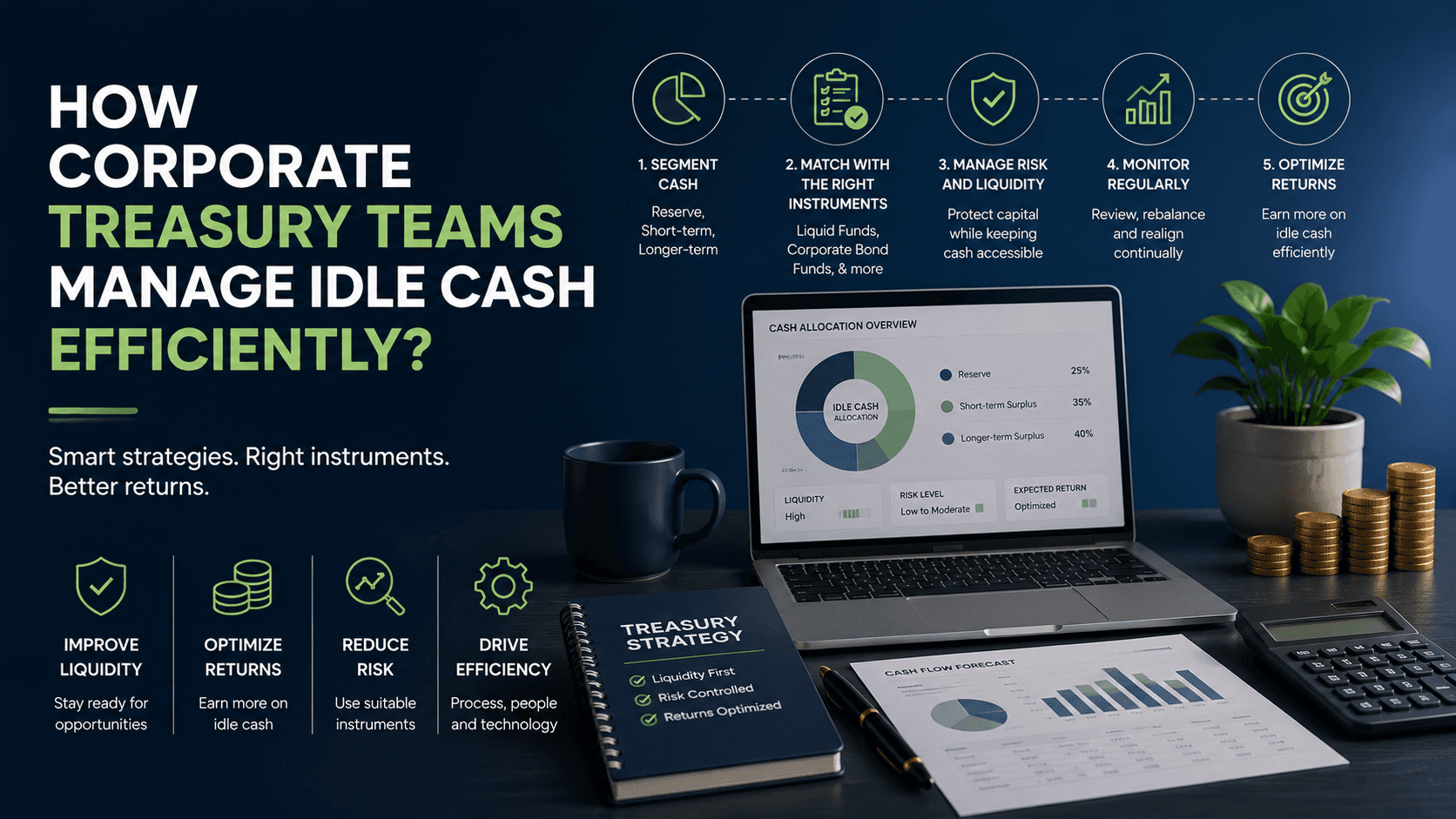
Most businesses eventually build some version of a treasury function, even if it's just one person tracking balances across a few accounts. What separates a mature treasury team from that early setup isn't access to fancier instruments. Good idle cash management at scale comes down to process, a repeatable way of knowing what's surplus, where it should sit, and when it needs to be pulled back.
Setting a clear cash reserve target
Every treasury team starts with a number. This is the minimum cash a business needs to keep fully liquid to cover operating expenses, payroll, and near-term obligations without disruption. The target isn't arbitrary. It's usually built from a rolling cash flow forecast, adjusted for how predictable the business's revenue and payment cycles actually are. A business with steady, contracted revenue can run a tighter reserve than one with lumpy, seasonal cash flow, and treasury teams revisit this number regularly rather than setting it once and leaving it fixed.
Segmenting cash beyond the reserve
Once the reserve target is set, everything above it gets treated differently, not as one undifferentiated pool of surplus, but split by how soon each portion might realistically be needed.
Category | Typical horizon | Treatment |
Reserve | Immediate | Stays fully liquid, untouched |
Short-term surplus | Days to weeks | Deployed into liquid or overnight funds |
Medium-term surplus | Weeks to months | Deployed into money market funds or sweep-in FDs |
Longer-term surplus | 6 months to a year or more | Considered for corporate bond funds or similar, where more return is worth the added duration |
This segmentation is what allows a treasury team to avoid the two common failure modes, holding everything too conservatively and leaving return on the table, or reaching for yield on cash that actually needed to stay liquid.
Choosing instruments based on mandate, not habit
Corporate bond mutual funds tend to enter the picture specifically for that longer-term surplus bucket, cash a treasury team is confident won't be needed for a while, where a bit more duration and credit exposure is an acceptable trade for better returns than a liquid fund would offer. Treasury teams generally stick to high-rated (AAA or AA) corporate bond funds for this purpose, since chasing extra yield from lower-rated paper introduces exactly the kind of risk a reserve-first approach is meant to avoid.
The instrument choice always follows from the mandate for that specific bucket of cash, not the other way around. This mandate-first thinking is really an extension of the same discipline finance leaders are increasingly expected to bring to cash decisions more broadly: How to multiply idle cash: strategies every CFO should know
Why this remains harder than it should be
Even well-resourced treasury functions struggle with this in practice. EY India's 2025 Treasury Survey, based on responses from 85 treasury leaders across the country, found that more than 70% of Indian treasury teams still depend heavily on spreadsheets, and only about a quarter had launched any AI pilots to improve forecasting or automation.
That gap matters, since manual tracking makes it genuinely harder to know, with confidence, how much cash is truly surplus at any given moment, which is exactly the starting point every other step in this process depends on.
Mutual fund investments are subject to market risk. Please read scheme-related documents carefully before investing. Past performance is not indicative of future returns.
Building in a regular review cycle
Segmentation and instrument selection only work if they're revisited on a set schedule. Treasury teams typically review their cash position weekly or biweekly, checking actual balances against forecast, and adjusting the split across instruments as revenue timing, upcoming obligations, or rate conditions shift. A structure that made sense last quarter can quietly stop fitting the business without anyone noticing, unless someone's actually checking on a fixed cadence.
Making this sustainable, not dependent on one person
The businesses that manage this well don't rely on institutional memory. They document the reserve target, the segmentation rules, and the approved instruments per bucket, so the process holds up even as the person responsible for it changes. This matters more than it sounds, since a well-run treasury function should be a system the business runs, not a habit that lives in one finance team member's head.
For a deeper look at building this kind of structure without giving up access to your cash, this covers it in detail: How to deploy idle cash without compromising liquidity
Turnover, promotions, and team changes are normal, but they shouldn't mean cash management resets from scratch every time someone new takes over.
FAQs
1. How is treasury-level cash management different from what a small business does?
The core principles are the same: segmentation, reserve targets, matched instruments, just applied with more structure and formality as the amounts and complexity grow.
2. Why do treasury teams use corporate bond funds instead of just liquid funds for everything?
Corporate bond funds suit surplus with a longer, more confident time horizon, where the added return justifies the extra duration and credit risk. Liquid funds remain the better fit for shorter-term surplus.
3. How often should a treasury team review its cash segmentation?
Weekly or biweekly works well for most organizations, with more frequent reviews during periods of changing cash flow or market conditions.
4. Is manual tracking still common even at larger companies?
Yes. Industry survey data shows a majority of treasury teams in India still rely significantly on spreadsheets, even at organizations with meaningful scale.
5. Can a treasury team change its segmentation buckets once they're set, or should they stay fixed?
They should be revisited, not fixed permanently. As the business's revenue predictability, obligations, or growth stage change, the boundaries between reserve, short-term, and longer-term surplus often need to shift too, which is part of why the regular review cycle matters as much as the initial segmentation itself.
Back to all notes
Finance
7 mins
Why India's banks are sitting on excess cash and what it could mean for short-term yields?
India's banking system is holding an unusually large cash surplus right now, but the surplus actually comes from two distinct sources layered together: durable liquidity released through 2025's CRR cuts, and a fresh, acute forex inflow spike in 2026. This piece unpacks both and walks through exactly how this kind of surplus transmits into lower short-term yields.
Finance
7 mins
13-Week Cash Flow Forecasting: A Practical Framework for Finance Teams
A 13-week cash flow forecast is a rolling, weekly, direct-method projection of cash receipts and disbursements across one fiscal quarter, the standard tool finance teams use for short-term liquidity management. This piece covers exactly how to build one, the discipline that makes it actually work, and the mistakes that most commonly undermine it.
Finance
7 mins
SEBI's Proposed Net Settlement for Mutual Funds: What Changes for Corporate Investors?
SEBI's September 3, 2026 consultation paper proposes allowing mutual fund schemes to net their own cash market fund obligations, rather than settling every buy and sell on a gross basis. This piece covers what the proposal actually does, what it doesn't change for corporate investors, and which fund categories it's most relevant to.