Finance
6 mins
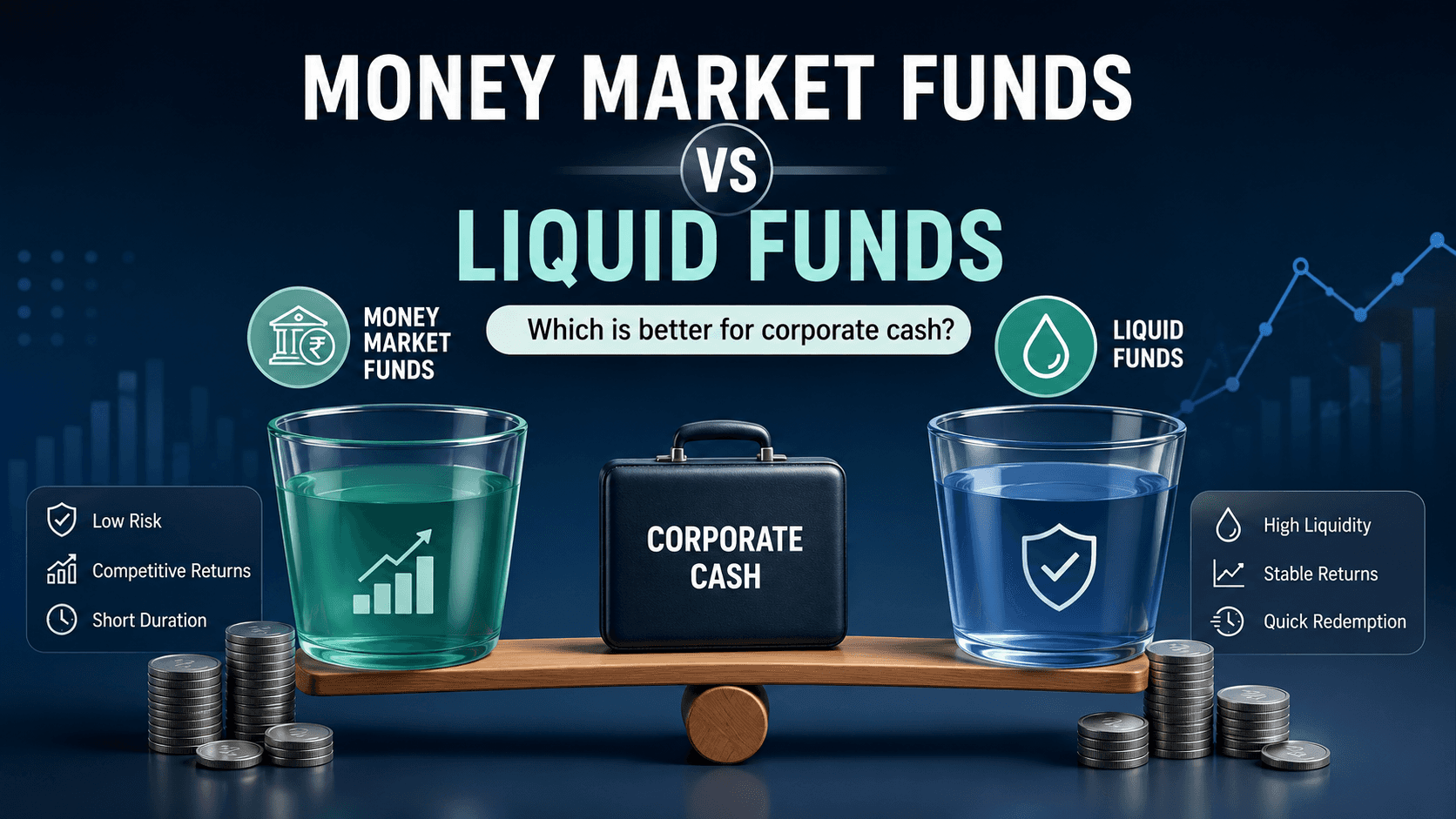
Once a business has settled on liquid funds as a reasonably safe place for surplus, a natural next question comes up: what about money market funds, are they better, worse, or just different? The honest answer is that they're built for a slightly different job, and knowing which one fits your situation matters more than picking whichever sounds safer.
What are liquid funds?
Liquid funds are open-ended debt mutual funds that invest in money market and debt instruments with a maximum maturity of 91 days, as defined under SEBI's official categorization framework maintained by AMFI. This short maturity window keeps interest rate and credit risk low, and redemptions are typically processed within one working day, with many funds offering instant redemption on a portion of the amount. Liquid funds are usually the first instrument businesses reach for once they've identified genuine surplus cash.
What are money market funds?
Money market funds sit in the same broad short-term debt category as liquid funds, but with a longer maturity ceiling, up to one year, per the same SEBI categorization. They invest in instruments like commercial paper, certificates of deposit, and treasury bills, similar building blocks to liquid funds, just held for a bit longer. That extra duration typically comes with a modest increase in yield, along with a slightly higher sensitivity to interest rate movements.
Key differences at a glance
Parameters | Liquid funds | Money market funds |
Maximum maturity | 91 days | 1 year |
Typical redemption | Within 1 working day | Within 1 working day, sometimes longer |
Risk level | Low | Low, marginally higher than liquid funds |
Return potential | Slightly lower | Slightly higher |
Best suited for | Cash needed within a few weeks | Cash needed within a few months |
Mutual fund investments are subject to market risk. Please read scheme-related documents carefully before investing. Past performance is not indicative of future returns.
Which is safer?
Liquid funds carry marginally lower risk, purely because of the shorter maturity ceiling. A portfolio holding instruments maturing within 91 days has less time to be affected by interest rate swings than one holding instruments out to a year. That said, the difference in practice is small; both categories sit toward the low-risk end of the debt fund spectrum, and neither is risk-free.
We've covered how liquid funds compare against other low-risk options here: Best low-risk options to invest idle cash in 2026
Which offers better returns?
Money market funds generally edge out liquid funds on yield, since they can hold instruments with slightly longer maturities and capture a bit more coupon income as a result. The gap isn't usually dramatic, often a fraction of a percentage point in typical rate environments, but it can matter on larger cash balances held for the full duration.
When to choose liquid funds
Liquid funds make sense for surplus you might need within a few weeks, cash tied to near-term obligations, a rolling operating buffer, or funds you're not fully certain about the timeline for. The speed and near-certainty of redemption matters more here than squeezing out extra yield.
When to choose money market funds
Money market funds fit better for surplus with a longer, more confident time horizon, say two to six months out, where you're comfortable holding slightly longer-dated instruments in exchange for a bit more return. This works well as part of a broader liquidity ladder, where different portions of surplus are matched to different instruments based on when each is actually needed.
We've laid that structure out here: How to deploy idle cash without compromising liquidity
How both compare to corporate bond funds
Corporate bond funds sit further out on the risk and duration spectrum than either liquid or money market funds. They hold corporate debt with maturities typically over a year, which brings more interest rate sensitivity and more credit risk tied to the specific issuers held. Returns can be higher, but so can volatility; corporate bond fund NAVs can move more visibly with rate changes than liquid or money market funds.
These generally aren't a fit for short-term operating surplus, but can be worth considering for cash a business is confident won't be needed for a year or more, and where a bit more risk is genuinely acceptable.
Picking between them without overcomplicating it
Most businesses don't need to choose one category exclusively. A common approach is splitting surplus across both, liquid funds for the portion needed sooner, money market funds for the portion with a longer runway, reviewing the split periodically as cash flow patterns shift.
If working out that split isn't something your team has bandwidth to revisit regularly, KodoNorth is built to handle Idle Cash Management.
FAQs
1. Can I lose money in a money market fund?
It's uncommon but not impossible. Money market funds carry low risk, not zero risk, since they hold debt instruments subject to some credit and interest rate movement.
2. Is the return difference between liquid and money market funds significant?
It's usually modest, often a fraction of a percentage point, though it can add up on larger balances held for longer periods.
3. Can I redeem a money market fund as quickly as a liquid fund?
Often yes, within one working day, though it's worth confirming with the specific fund since processing times can vary slightly more than with liquid funds.
4. Should a business use both liquid and money market funds at the same time?
Yes, this is common. Splitting surplus across both, matched to different time horizons, tends to work better than putting everything into one category.
5. How do corporate bond funds fit into this comparison?
They sit at a higher risk and return level than both liquid and money market funds, suited to surplus with a longer time horizon and more risk tolerance, not short-term operating cash.
Back to all notes
Finance
5 mins
Should you prepay business loans or invest surplus cash? A CFO’s decision guide
Prepaying a loan delivers a guaranteed saving equal to its interest rate, while investing surplus delivers a variable return that has to beat that rate to justify itself. This guide sets out a practical framework: compare rates, check prepayment charges, protect your liquidity buffer, and treat revolving credit differently from term loans.
Idle Cash Investment
6 mins
Surplus cash investment for companies: Options, rules and strategy (2026)
Surplus cash is money beyond operating needs and your reserve buffer. Companies in India can place it in overnight, liquid, and money market funds, treasury bills, FDs, and, for longer horizons, arbitrage funds. This guide covers the options, the rules that apply, and a simple allocation framework, linking to deeper pieces where a topic needs more room.
Finance
5 mins
India's GST Collections Hit ₹2.04 Lakh Crore in September 2026: What It Means for Business Liquidity
India's gross GST collections rose 14.7% to ₹2.04 lakh crore in September 2026, led by imports. For businesses, the real signal is in cash timing, not the headline.