Finance
5 mins
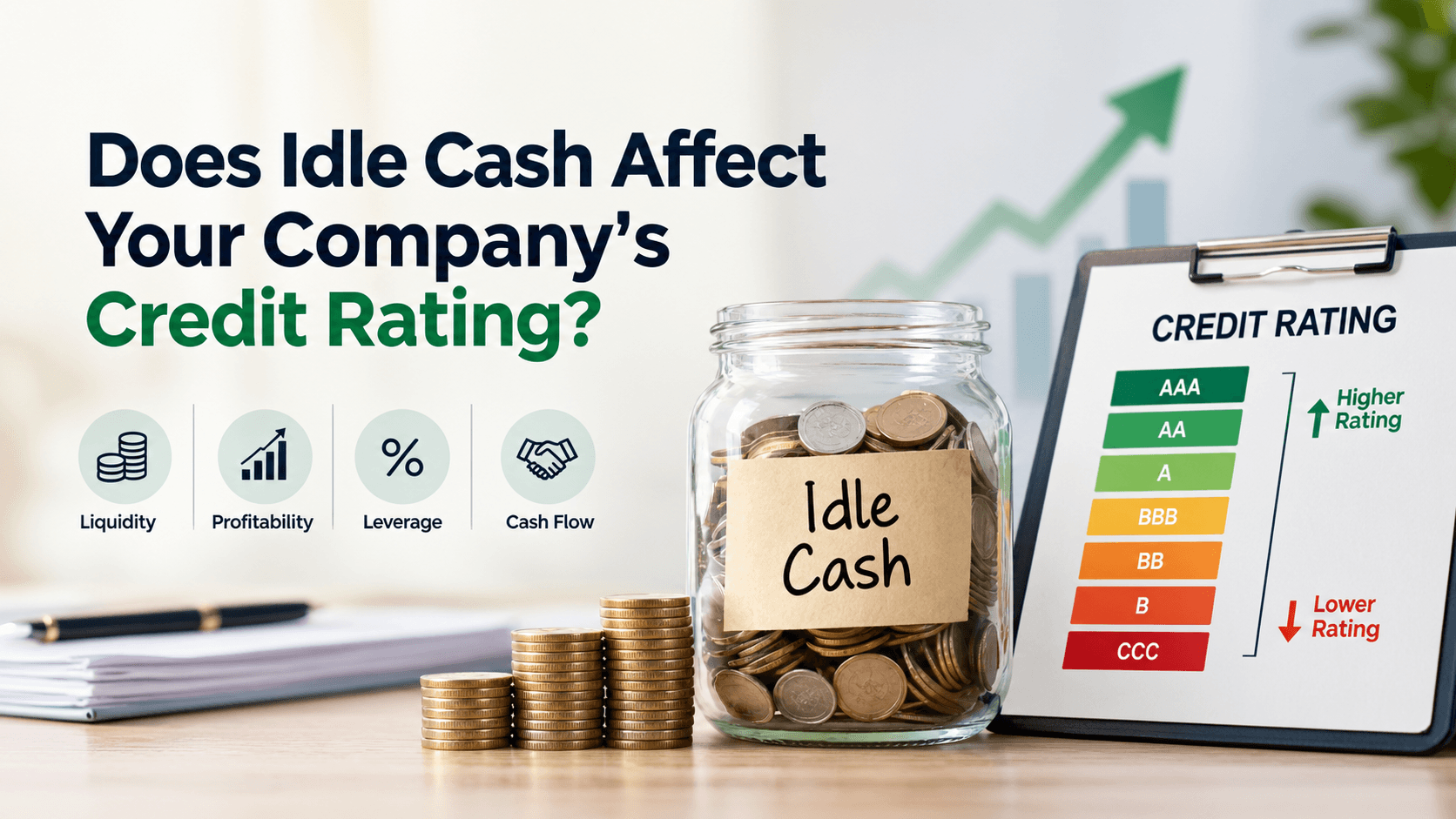
It's a reasonable question to ask: if a business is sitting on a healthy cash reserve, does that actually translate into a better credit rating? The honest answer, grounded in how CRISIL and ICRA actually publish their methodology, is more nuanced than a simple yes. Good surplus cash management isn't really about optimizing for a rating agency's view, but understanding how they actually weigh cash is useful context for any business that borrows or plans to.
This piece works through what CRISIL and ICRA's own published criteria say about cash and liquidity, and what that means practically.
Does holding more cash improve a company's credit rating?
Not in a direct, one-to-one way. CRISIL's published approach to financial ratios evaluates eight core parameters when assessing credit quality: capital structure, interest coverage, debt service coverage, net worth, profitability, return on capital employed, net cash accrual to total debt, and current ratio. Cash and liquidity feed into several of these, but they sit alongside leverage, profitability, and debt servicing capacity, not above them. A business with a strong cash position but weak underlying leverage or profitability won't see that cash single-handedly lift its rating.
How do credit rating agencies actually view idle cash?
Both major Indian agencies explicitly name cash as part of their liquidity assessment. ICRA's methodology divides its financial analysis into five categories: profitability, leverage, coverage, liquidity, and cash flows, with liquidity specifically assessed as an entity's ability to meet short-term obligations from internal resources, which ICRA names as including "unencumbered cash and cash equivalents." CRISIL similarly evaluates liquidity as part of its framework, considering the extent of short-term funding sources relative to near-term uses.
So idle cash isn't ignored; it's a genuine, named input into how agencies assess liquidity. The nuance is in how much weight that input carries relative to everything else.
Mutual fund investments are subject to market risk. Please read scheme-related documents carefully before investing. Past performance is not indicative of future returns.
Why cash is a supplementary factor, not a primary driver
This is the part worth understanding precisely. In CRISIL's rating criteria for short-term debt, the agency states directly that liquidity backup, which includes cash and unpledged fixed deposits, "does not lead to a higher rating than indicated by the issuer's own creditworthiness." In other words, there's an effective ceiling: cash and liquidity can support a rating that's already justified by the underlying business and financial profile, but they can't substitute for a weak one. A business with thin margins, high leverage, or unpredictable cash flow generation won't see a large cash balance meaningfully offset those weaknesses in the eyes of a rating agency.
Can too much idle cash hurt a business?
Not in a direct, rating-penalty sense, agencies don't lower a rating simply because a business holds "too much" cash. But there's an indirect channel worth knowing about. Return on capital employed is one of CRISIL's eight core rating parameters, and a large pile of cash sitting idle, earning close to nothing, drags down that ratio, since the capital base grows without a corresponding increase in earnings. A rating rationale might not cite "excess idle cash" as a weakness explicitly, but inefficient capital use that shows up in weaker profitability or return ratios absolutely can factor into the broader assessment.
What's the relationship between liquidity and creditworthiness?
Liquidity and creditworthiness are related but distinct concepts, and conflating them is a common mistake. Creditworthiness is a longer-term judgment about whether a business can meet its obligations over the life of its debt, built from profitability, leverage, and cash flow generation. Liquidity is a shorter-term, point-in-time measure of whether a business can meet obligations due in the near term.
A business can have genuinely strong creditworthiness with a comparatively lean cash position if its underlying cash flow generation is reliable, and a weaker creditworthiness profile with a large cash balance, if that cash isn't being generated sustainably by the core business.
We've covered the broader concept of liquidity, and why it deserves attention as a distinct dimension from safety or creditworthiness, here: What is liquidity in investing?
What this means practically for a CFO
The practical takeaway isn't to chase a specific cash balance for rating purposes. It's to recognize that rating agencies are looking at the same underlying discipline good idle cash management already calls for, knowing exactly how much cash is genuinely available, how it's being used, and whether it's actually productive. A business that can clearly identify and articulate its cash position, what's buffer, what's genuine surplus, and what that surplus is earning, is in a stronger position during a rating review than one that's simply accumulated cash without a clear rationale. We've covered how to actually identify that position here: How to identify idle cash in your business: a CFO's checklist
FAQs
1. Does holding more cash improve a company's credit rating?
Only at the margins. Cash and liquidity are genuine inputs into how agencies like CRISIL and ICRA assess credit quality, but they're supplementary to core factors like leverage, profitability, and cash flow generation, and can't push a rating above what those fundamentals support.
2. How do credit rating agencies view idle cash?
Both CRISIL and ICRA explicitly include cash and unencumbered cash equivalents in their liquidity assessment, evaluated as part of a broader framework rather than as a standalone factor driving the rating.
3. Can too much idle cash hurt a business's credit rating?
Not directly through a rating penalty, but indirectly. Idle cash that drags down return on capital employed, one of CRISIL's core rating parameters, can factor into a weaker overall assessment of financial performance.
4. What's the relationship between liquidity and creditworthiness?
Liquidity is a near-term measure of a business's ability to meet upcoming obligations. Creditworthiness is a longer-term judgment based on sustained profitability, leverage, and cash flow generation. The two are related but distinct; a business can be liquid without being highly creditworthy, and vice versa.
Back to all notes
Finance
5 mins
How are mutual fund returns taxed for companies in India? A CFO's guide
For companies, gains from debt-oriented mutual funds are taxed at the applicable corporate tax rate, whatever the holding period, with no indexation. Equity-oriented funds, including arbitrage funds, follow capital gains rates of 20% short-term and 12.5% long-term. Redemptions carry no TDS for resident investors, but dividend payouts do. This piece walks through each and how to compare options after tax.
Finance
5 mins
RBI's October 2026 MPC meeting: Will a rate hike change where you park idle cash?
The RBI's Monetary Policy Committee meets October 5-7, 2026, with the decision due October 7 at 10 AM IST. A Business Standard poll shows economists now expect a 25 basis point hike, following hawkish signals from the August meeting's minutes. This piece covers what's at stake, what a hike would mean for liquid fund returns, and what to do regardless of the outcome.
Finance
6 mins
DSO and DPO: How they affect your idle cash?
Days Sales Outstanding (DSO) measures how long it takes to collect payment after a sale. Days Payable Outstanding (DPO) measures how long a business takes to pay its own suppliers. Together, they directly determine how much cash sits trapped in the operating cycle versus how much is genuinely free to deploy. This piece covers the formulas, current benchmarks, and practical ways to improve both.