Finance
6 mins
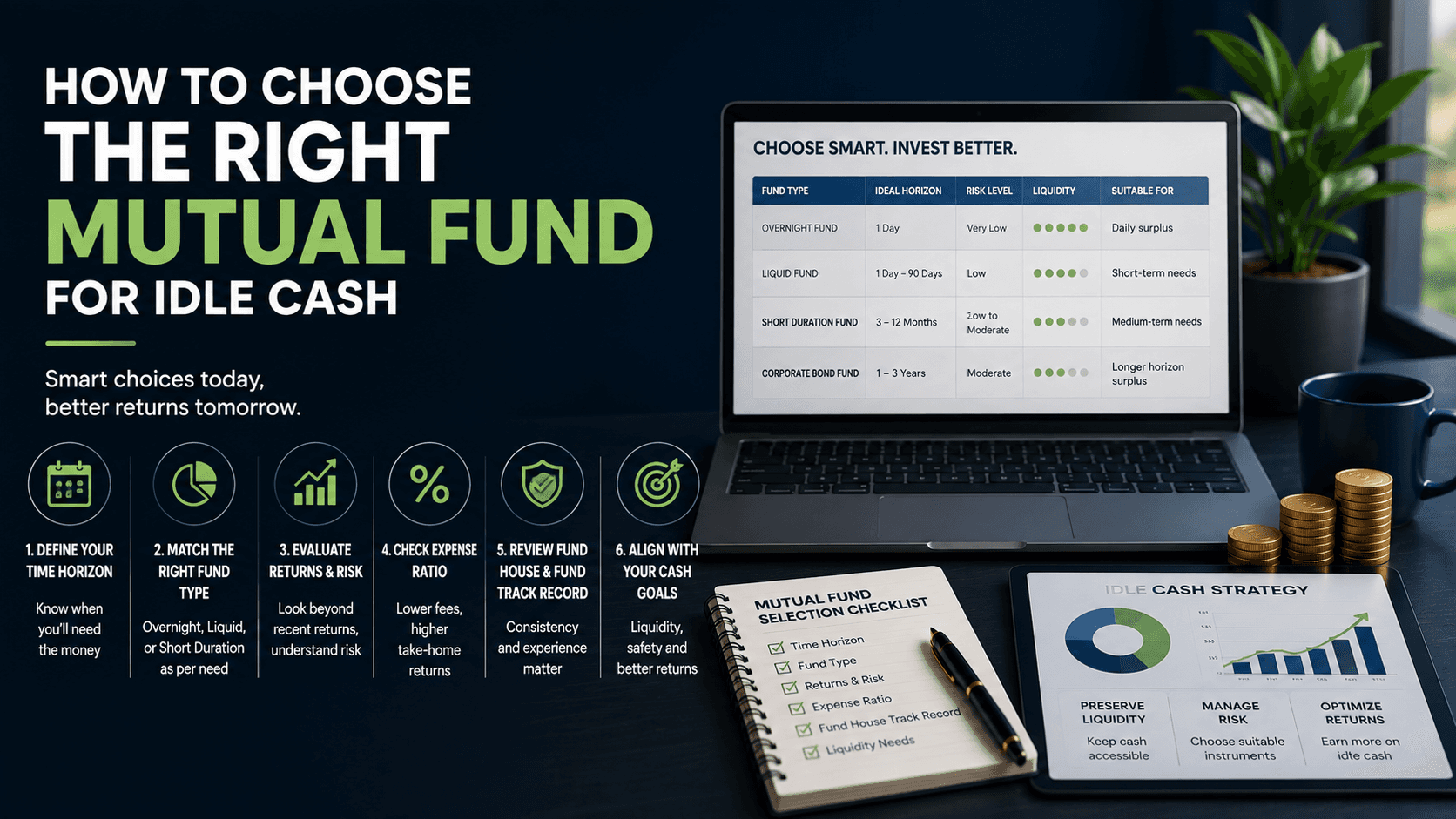
Most businesses approach fund selection the way an individual investor might, scanning a list, sorting by recent returns, and picking whatever's at the top. That approach works reasonably well for a personal long-term goal. It works badly for business surplus, where liquidity, risk, and cost accounting all matter more than squeezing out an extra fraction of a percent. Good idle cash management starts with a completely different question than "which fund performed best last year."
This piece walks through the actual criteria that should drive the decision, in the order they should matter.
Start with your time horizon, not the fund
Before looking at any specific fund, work out how soon this particular portion of surplus might actually be needed. Cash tied to near-term expenditure, or set aside for a known obligation, has no business sitting in something you can't exit quickly. Cash you're genuinely confident won't be touched for months can reasonably consider options with a bit more duration. Skipping this step and jumping straight to comparing funds is the single most common mistake, since it means picking an instrument before knowing what job it actually needs to do.
Check the fund category matches your actual need
Once the time horizon is clear, the fund category mostly follows. Liquid funds suit surplus needed within a few weeks. Overnight funds suit cash where next-day access matters most. Money market funds fit a slightly longer window. Corporate bond funds suit surplus with a genuinely longer runway. We've covered how these categories differ in more depth here: Debt mutual funds explained for businesses
Look at credit quality before yield
A higher yield on paper is never free. It's compensation for some form of additional risk, usually credit risk, in the underlying instruments held by the fund. Sticking to funds concentrated in high-rated (AAA or AA) paper matters more than chasing the top return on a comparison table, especially for corporate bond or money market funds where credit quality varies more between schemes than it does within liquid or overnight funds. We've covered how to think through this risk-return trade-off properly here: Understanding risk and return before investing business funds
Mutual fund investments are subject to market risk. Please read scheme-related documents carefully before investing. Past performance is not indicative of future returns.
Check the expense ratio, since it directly reduces your return
The expense ratio, what a fund charges to manage your money, comes straight out of your returns every year, regardless of performance. This is worth checking specifically now, since the framework itself just changed. SEBI approved a comprehensive overhaul of mutual fund expense structures effective April 1, 2026, separating the core management fee from statutory levies like GST and stamp duty, and cutting maximum charges across most fund size categories. For debt-oriented schemes, the shift means better transparency into what you're actually paying for management versus what's simply a pass-through tax or regulatory cost.
A lower expense ratio matters more for short-term debt categories specifically, since the return pool is already modest, and every basis point of cost eats into it proportionally more than it would for a higher-return category.
Confirm redemption speed and liquidity terms
Two funds in the same category aren't automatically identical on liquidity. Check the standard redemption timeline, typically one working day for liquid and overnight funds, and whether an instant redemption facility exists for smaller amounts. This matters more than it might seem, since a fund that technically fits your time horizon but has slower-than-expected redemption defeats the purpose of choosing a liquid instrument in the first place.
Check the AMC's track record specifically in debt categories
Not every fund house is equally strong across every category. Some asset management companies have a longer, more consistent track record specifically in debt and short-term categories, which tends to matter more for consistency of returns than headline performance in any single year. A fund house that's primarily known for equity products isn't automatically a poor choice for debt funds, but it's worth a closer look at their specific debt fund team and process before committing meaningful surplus.
Avoid over-optimizing for a small return difference
This is a genuinely common mistake worth calling out directly. Chasing an extra 0.2% to 0.3% in yield by moving away from a familiar, well-managed fund toward a less established one rarely justifies the added uncertainty, especially for business surplus where the goal is capital preservation first. The marginal gain on a moderate surplus balance is usually small in absolute terms, while the downside risk, even if small, is disproportionately larger. For businesses, managing surplus cash also needs to sit alongside broader spend management practices, so cash isn't only earning efficiently but being managed with visibility and control across the business.
Bringing this together into a simple checklist
Once time horizon, fund category, credit quality, cost, liquidity terms, and AMC track record are all checked, the decision usually becomes straightforward, often with only one or two funds genuinely fitting all the criteria for a given portion of surplus. Building this into a repeatable process, rather than re-deciding from scratch every time, is what actually makes fund selection manageable for a business without a dedicated treasury function.
Getting this framework right once means the decision gets easier every time surplus needs a home, rather than starting from a blank page each time a new tranche of idle cash needs to be deployed.
FAQs
1. Should a business always pick the fund with the highest recent return?
No. Recent performance can reflect temporary conditions rather than consistent management quality, and a higher return often comes with additional credit or duration risk that may not suit business surplus.
2. How much does the expense ratio actually matter for a business?
More than it seems, especially for low-return categories like liquid or overnight funds, where a lower expense ratio directly preserves more of an already modest return.
3. Is it worth switching funds to chase a slightly better yield?
Usually not, if the difference is small. The added uncertainty of an unfamiliar fund rarely justifies a marginal return improvement for business surplus.
4. How important is the fund house's track record compared to the fund itself?
Both matter, but a strong, consistent AMC with specific experience in debt categories generally provides more reliability than a single standout fund from a less established manager.
5. What's the biggest mistake businesses make when choosing a mutual fund for surplus?
Skipping the time horizon step and comparing funds on returns alone, before actually working out what job the money needs the fund to do.
Back to all notes
Idle Cash Investment
4 mins
How to identify idle cash in your business: A CFO's checklist
Idle cash doesn't flag itself the way a missed payment or a revenue miss does. It just sits there, looking like financial strength. This checklist covers the specific signs that indicate a business is carrying idle cash, and a practical process for auditing it on a regular basis.
Idle Cash Investment
5 min read
How to deploy idle cash without compromising liquidity?
Most businesses avoid deploying idle cash because they're worried about losing access to it. That worry is fair, but it's usually solvable with the right structure. This piece covers how to allocate surplus cash across instruments based on when you'll actually need it back, so you can earn more without compromising on liquidity.
Idle Cash Investment
4 mins
How long should you park idle cash before investing it? A duration guide
There's no single answer to how long idle cash should sit before being invested; the right instrument depends entirely on the expected holding period. This piece breaks down which instrument fits which duration, from same-day cash to surplus held a year or more, and the actual break-even math behind the shortest thresholds.