Finance
4 mins
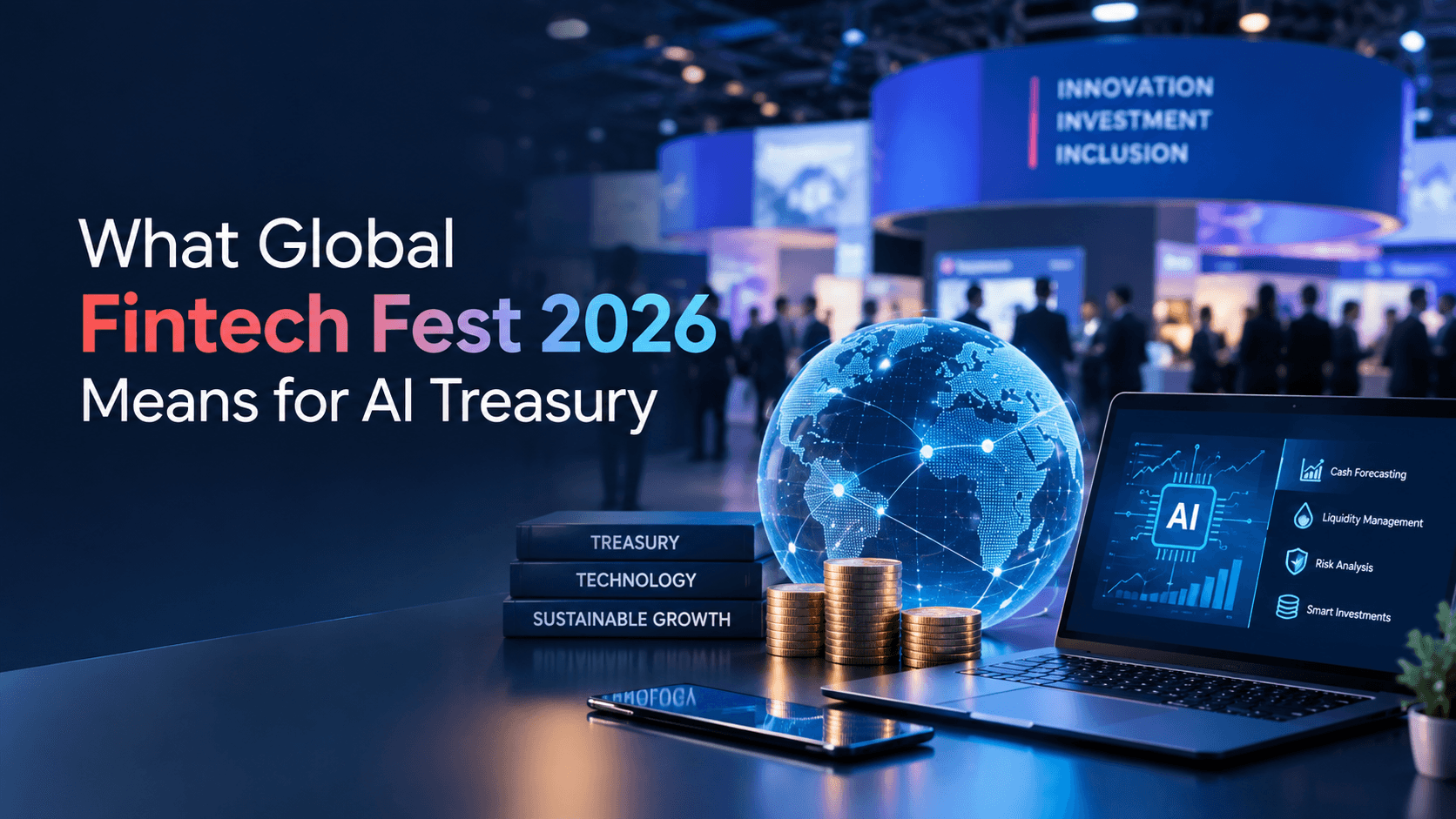
Global Fintech Fest, now in its seventh edition, has become the fixture the Indian financial services calendar plans around, over 100,000 attendees, regulators from the RBI, SEBI, and IFSCA, and international institutions including the Bank for International Settlements and J.P. Morgan. This year's theme, "Potential to Impact," was built on three pillars: agentic AI, tokenization, and quantum computing. Good idle cash management increasingly intersects with exactly the first of those themes, since agentic AI is the concept underpinning where treasury tools are actually headed, even though the event itself wasn't organized around treasury specifically.
This piece is honest about that distinction, what GFF 2026 actually covered, and what its central theme signals for AI-native treasury, without pretending the event addressed corporate treasury directly.
What Global Fintech Fest 2026 actually covered
The event ran September 8-11 at Mumbai's Jio World Centre, opened by Prime Minister Narendra Modi, and organized by the Payments Council of India, NPCI, and the Fintech Convergence Council, with support from the RBI, SEBI, IFSCA, and PFRDA. The confirmed agenda centered on UPI's continuing evolution and international expansion, the Account Aggregator framework, digital lending, and a dedicated Token Nxt zone spotlighting Indian AI innovation in fintech and banking. Reported developments coming out of the event included new approaches to fraud detection and AI-powered lending, alongside continued UPI credit expansion for Kisan Credit Card and PM MUDRA borrowers.
What is agentic AI, and why was it the centerpiece?
Agentic AI refers to AI systems capable of planning and carrying out a series of tasks with a degree of autonomy, working toward a defined objective rather than simply answering a single query or generating a single output. This is a meaningfully different concept from the chatbot-style AI most people are familiar with; an agentic system doesn't just tell you something, it can carry a task through multiple steps toward completion, within whatever boundaries it's been given.
Mutual fund investments are subject to market risk. Please read scheme-related documents carefully before investing. Past performance is not indicative of future returns.
How agentic AI connects to what "AI-native treasury" actually means
This is where the honest connection sits, as analysis rather than something the event itself stated. We've covered elsewhere what distinguishes an AI-native system from one with AI features bolted onto an existing process; the AI-native version is built to carry insight through to action, not stop at a report someone has to interpret manually. Agentic AI is essentially the more advanced, more capable version of that same idea, a system that doesn't just flag a pattern in your cash data, but can work through the steps toward acting on it, within the approval boundaries a business has set. GFF 2026 putting agentic AI at the center of its agenda is a signal about where AI capability generally is headed across financial services, and treasury tools are a natural, if not explicitly named, beneficiary of that broader shift.
We've covered the AI-native concept itself in more depth here: Why KodoNorth is called an AI-native treasury
What this signals for the future of corporate treasury management
If agentic AI matures the way the fintech industry broadly expects, based on the scale of attention it received at an event this size, treasury tools built on that foundation should be able to do more than surface a forecast or flag a pattern. They should increasingly be able to work through multi-step processes, identifying genuine surplus, matching it to an appropriate instrument based on a defined policy, and carrying that recommendation through to execution, within a business's own approval structure, rather than requiring a person to manually action every individual step.
We've covered where AI genuinely helps with idle cash management today, and where human judgment still has to stay firmly in the loop, here: AI in idle cash management: how it actually helps
What CFOs should actually take away from this
Not a mandate to overhaul anything immediately. Agentic AI in treasury is a direction the broader industry is clearly moving toward, evidenced by how central it was to an event of this scale, but it's still an emerging capability, not a mature, universally adopted standard. The practical takeaway is to understand the concept now, since tools built around it will increasingly define what "modern" treasury management actually looks like, and to evaluate any tool claiming this capability on whether it genuinely carries insight through to action, or whether "AI-native" is being used more loosely as a marketing label.
FAQs
1. What is AI-native treasury?
AI-native treasury refers to treasury systems built from the ground up around AI, continuously processing cash data and designed to carry insight through to an actual recommendation or action, rather than having AI features added onto an existing manual process.
2. What did Global Fintech Fest 2026 cover?
GFF 2026, held in Mumbai from September 8-11, centered its agenda on agentic AI, tokenization, and quantum computing, alongside continuing themes like UPI expansion, the Account Aggregator framework, and digital lending.
3. How is AI changing corporate treasury management?
AI is shifting treasury tools from generating static reports and forecasts toward systems that can identify patterns, like genuine cash surplus, and work through multiple steps toward acting on them, within a business's defined approval boundaries.
4. What fintech trends matter for CFOs in 2026?
Agentic AI is the most significant trend for finance functions broadly, since it represents a shift from AI that informs decisions to AI that can help execute multi-step processes, a capability increasingly relevant to treasury and cash management specifically.
Back to all notes
Finance
5 mins
Cash Sweep Accounts: How Automated Sweeps Work for Businesses
A cash sweep account links your current or savings account to a fixed deposit, automatically moving balances above a set threshold into the FD to earn interest, and moving funds back the moment the account needs them. This piece covers exactly how the mechanism works, what to check before setting one up, and where it falls short.
Finance
7 mins
Corporate Treasury Glossary: 30+ Cash & Liquidity Terms Every CFO Should now
A quick-reference glossary covering the cash flow, deployment, risk, and governance terms that come up regularly in corporate treasury and idle cash management, organized by category with short, practical definitions.
Idle Cash Investment
4 mins
How to identify idle cash in your business: A CFO's checklist
Idle cash doesn't flag itself the way a missed payment or a revenue miss does. It just sits there, looking like financial strength. This checklist covers the specific signs that indicate a business is carrying idle cash, and a practical process for auditing it on a regular basis.