Financce
5 mins
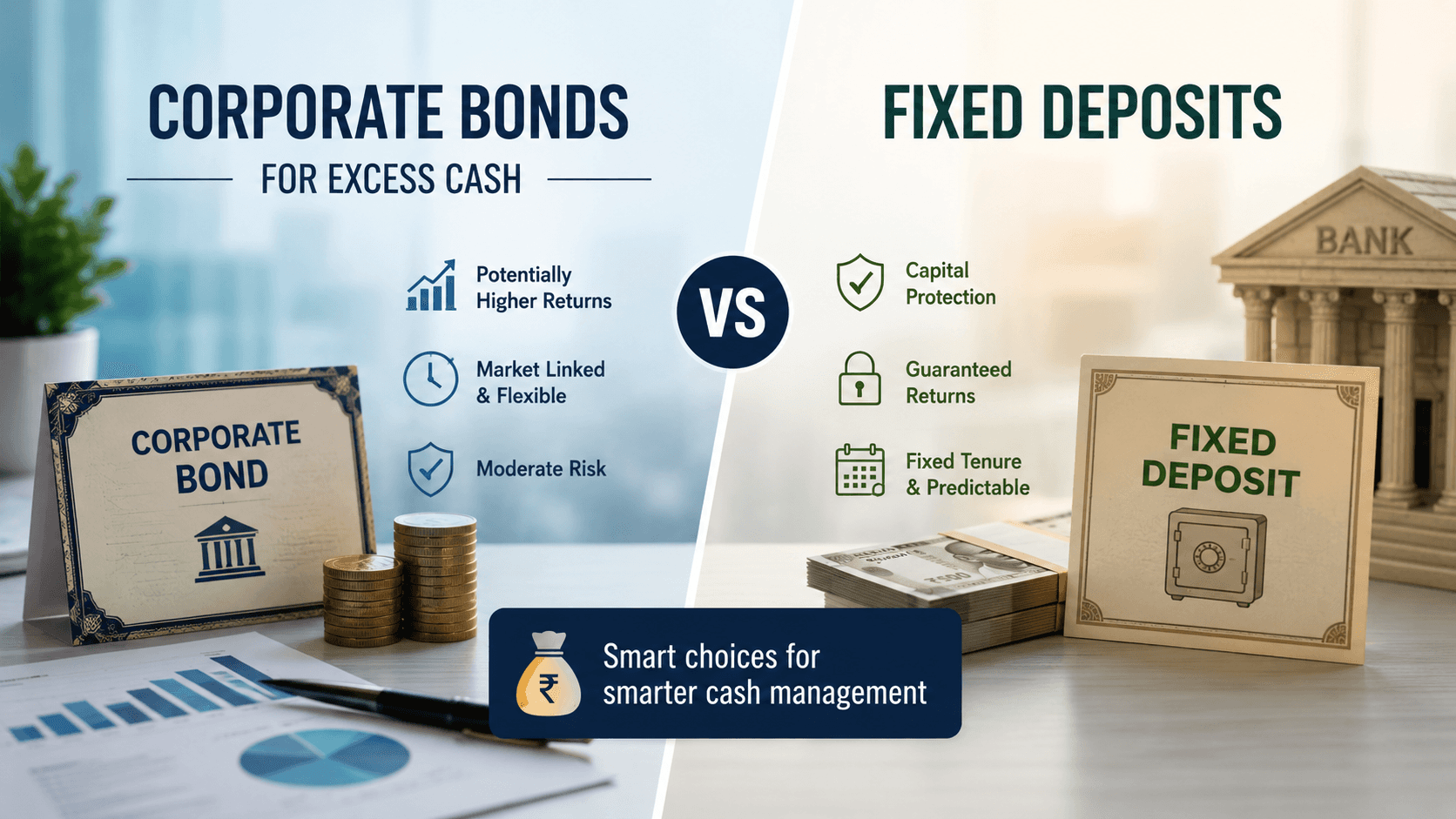
Once a business has its short-term surplus handled through liquid or overnight funds, a longer question usually comes up: what about the cash that's genuinely not needed for a year or more? That's typically where the comparison between corporate bond funds and fixed deposits starts, two of the more established options for excess cash with a longer runway.
What are corporate bond funds?
Corporate bond mutual funds are debt funds that invest primarily in bonds issued by companies, rather than the government. Fund managers select bonds based on credit quality, yield, and duration, aiming to deliver returns through a mix of interest income and any price appreciation on the underlying bonds. Because these are market-linked instruments, the fund's value can move slightly with interest rate changes, though high-rated corporate bond funds are generally considered a moderate-risk category, well below equities.
What are fixed deposits?
Fixed deposits are a straightforward savings instrument. You deposit a lump sum for a fixed tenure and earn a pre-agreed interest rate that doesn't change regardless of what happens in the broader market. Bank FDs are the most common version, but businesses also have the option of NBFC or corporate FDs, which typically offer higher rates in exchange for taking on the credit risk of the issuing company rather than a bank.
Safety: Where the two genuinely differ
This is one of the clearest differences between the two. Bank fixed deposits come with deposit insurance, but that protection has a real limit. The DICGC, a wholly owned subsidiary of the RBI, insures deposits up to a maximum of ₹5 lakh per depositor per bank, covering both principal and accrued interest combined. Anything held beyond that limit in a single bank carries the bank's own credit risk, not government-backed protection.
Corporate bond funds don't carry deposit insurance in the same sense, since they're market-linked mutual fund products, not bank deposits. Their safety instead comes down to the credit quality of the underlying bonds the fund holds. A fund concentrated in high-rated (AAA or AA) corporate bonds carries meaningfully less risk than one holding lower-rated paper for extra yield.
Mutual fund investments are subject to market risk. Please read scheme-related documents carefully before investing. Past performance is not indicative of future returns.
Returns: Where corporate bond funds usually pull ahead
Fixed deposit rates at major banks have generally hovered in the 6% to 7.5% range recently. Corporate bond funds have historically aimed to deliver somewhat higher returns, since they can capture yield from a diversified basket of corporate debt rather than a single fixed rate. That said, corporate bond fund returns aren't guaranteed the way FD returns are; they can vary with interest rate movements and credit market conditions, so the higher return potential comes with a bit more uncertainty attached.
Liquidity: Fixed deposits lock you in; funds generally don't
A traditional fixed deposit locks your money in for the agreed tenure. Breaking it early usually means a penalty on the interest earned. Corporate bond funds, being open-ended mutual funds, can typically be redeemed at any time, though redemption proceeds may take a day or two to reach your account, and there's a small chance of exiting during a period when the fund's value has dipped slightly.
This kind of trade-off, more return in exchange for less certainty around access, shows up across most excess cash decisions. We've gone deeper into it here: The hidden cost of keeping excess cash in your bank account
Taxation: A meaningful difference for businesses
Interest earned on fixed deposits is added to income and taxed at the applicable slab or corporate rate every year, regardless of whether the interest is withdrawn. Corporate bond fund gains, since April 2023, are also taxed at the applicable slab rate on redemption rather than at a preferential capital gains rate, which narrowed the tax gap that debt funds used to have over FDs.
That said, tax only applies to bond funds when units are actually redeemed, which gives businesses a bit more control over the timing of their tax liability compared to FD interest, which typically accrues and gets taxed annually regardless of your cash needs.
Comparing them side by side
Parameters | Fixed deposits | Corporate bond funds |
Returns | Fixed, roughly 6-7.5% | Market-linked, historically higher potential |
Safety | DICGC insured up to ₹5 lakh (bank FDs) | Depends on underlying bond credit quality |
Liquidity | Locked in, penalty for early exit | Generally redeemable anytime |
Taxation | Taxed annually as income accrues | Taxed at redemption, at slab rate |
Best suited for | Predictable, guaranteed short-term returns | Longer-term surplus, some risk tolerance |
When fixed deposits make sense
FDs suit businesses that want complete certainty about what they'll earn and when, with no tolerance for even small fluctuations in value. They also work well for surplus with a genuinely fixed, known timeline, where the FD's tenure can be matched precisely to when the cash will actually be needed.
When corporate bond funds make sense
Corporate bond funds fit better for excess cash with a longer runway and some flexibility around exact timing, where the potential for better returns is worth accepting some market-linked movement in exchange.
For finance leaders weighing this as part of a broader cash strategy, this covers the decision-making framework CFOs typically use: How to multiply idle cash: strategies every CFO should know
Splitting rather than choosing one
Most businesses don't need to pick exclusively between the two. A common approach uses fixed deposits for the portion of surplus with a known, fixed timeline, and corporate bond funds for excess cash with a longer, more flexible horizon, reviewing the split as cash flow needs shift.
If working out that split isn't something your team has time to revisit regularly, KodoNorth is built to handle it.
FAQs
1. Are corporate bond funds riskier than fixed deposits?
Generally yes, since they're market-linked and don't carry deposit insurance the way bank FDs do. High-rated corporate bond funds carry moderate risk, well below equities, but not zero.
2. Is my entire FD amount protected if the bank fails?
Only up to ₹5 lakh per depositor per bank, covering both principal and interest combined. Amounts beyond that aren't covered by deposit insurance.
3. Can I withdraw from a corporate bond fund before a fixed tenure, like I can't with an FD?
Yes, corporate bond funds are open-ended and can generally be redeemed anytime, unlike FDs, which typically penalize early withdrawal.
4. Which option is more tax-efficient for a business?
Since April 2023, both are largely taxed similarly, at the applicable slab rate, though bond fund gains are only taxed at redemption, giving some control over timing versus FD interest, which is taxed annually as it accrues.
5. Should a business use both instruments at once?
Often yes. Splitting excess cash between FDs for known, fixed-timeline needs and corporate bond funds for longer, more flexible surplus tends to balance safety and return better than relying on just one.
Back to all notes
Finance
5 mins
Should you prepay business loans or invest surplus cash? A CFO’s decision guide
Prepaying a loan delivers a guaranteed saving equal to its interest rate, while investing surplus delivers a variable return that has to beat that rate to justify itself. This guide sets out a practical framework: compare rates, check prepayment charges, protect your liquidity buffer, and treat revolving credit differently from term loans.
Idle Cash Investment
6 mins
Surplus cash investment for companies: Options, rules and strategy (2026)
Surplus cash is money beyond operating needs and your reserve buffer. Companies in India can place it in overnight, liquid, and money market funds, treasury bills, FDs, and, for longer horizons, arbitrage funds. This guide covers the options, the rules that apply, and a simple allocation framework, linking to deeper pieces where a topic needs more room.
Finance
5 mins
India's GST Collections Hit ₹2.04 Lakh Crore in September 2026: What It Means for Business Liquidity
India's gross GST collections rose 14.7% to ₹2.04 lakh crore in September 2026, led by imports. For businesses, the real signal is in cash timing, not the headline.